Industrial Pipe Hangers and Supports Technical Analysis
Selecting the correct support system for piping is often the difference between a facility that operates for decades and one plagued by constant maintenance shutdowns. In industrial environments, the physical load is only one part of the equation; thermal expansion, vibration, and corrosive atmospheres dictate the actual lifespan of the installation.
Whether managing a petrochemical plant or a complex HVAC network, engineers must navigate a vast array of types of pipe hangers and supports to ensure structural safety. The failure to match a support type to its specific environmental stressor often leads to pipe sagging, joint leakage, or catastrophic structural failure.
This technical guide analyzes the mechanical logic behind different support systems and provides a framework for selecting hardware based on load requirements and environmental exposure.
Mechanics of Pipe Support Systems
At its core, pipe support is not about simply "holding" a pipe in place, but about managing the forces acting upon it. These forces include dead loads (the weight of the pipe and fluid), live loads (external pressure or wind), and dynamic loads caused by thermal expansion or fluid surge.
An effective support system must balance rigidity with flexibility. If a support is too rigid, thermal expansion can warp the pipe; if it is too loose, vibration can lead to fatigue failure at the joints.
Primary Categories and Technical Roles
The industry categorizes supports based on the direction of the force they counteract. Rigid hangers are designed to provide fixed positioning, typically used in low-temperature systems where movement is negligible. In contrast, variable spring hangers are employed in high-temperature steam lines to accommodate vertical movement while maintaining a constant support force.
Guides and anchors serve as the "traffic control" of the piping system. Anchors completely restrain the pipe in all directions, creating a fixed point of reference, while guides allow longitudinal movement while preventing lateral shifting. This prevents the pipe from "snaking" during temperature fluctuations.
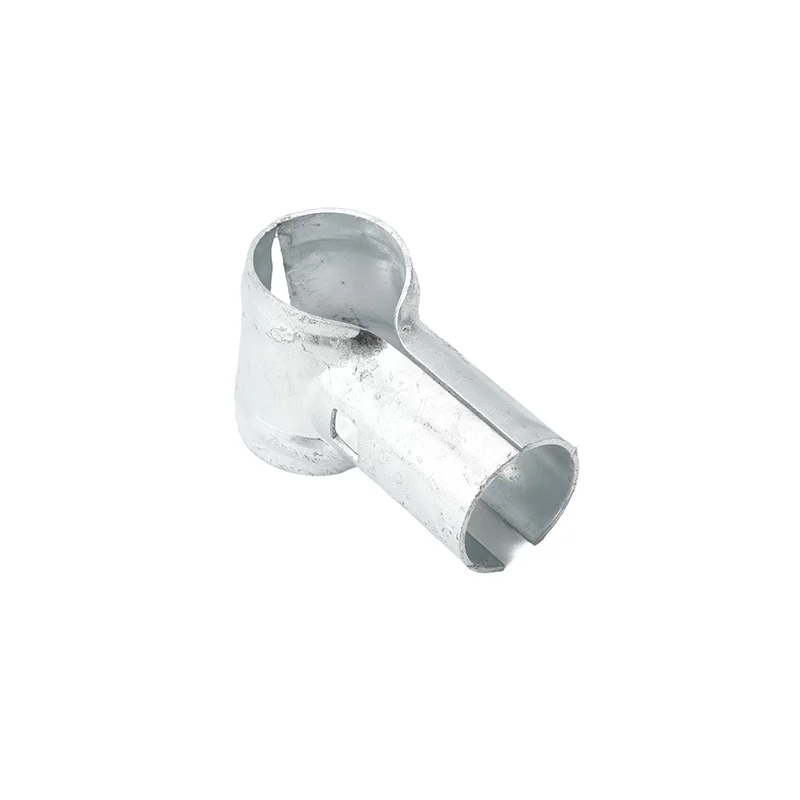
Finally, clamps and rail supports provide the interface between the pipe and the structural beam. For example, specialized T-Joint clamps, such as those engineered for 1 5/8" posts and 1 3/8" rails, ensure that the connection between the vertical support and the horizontal rail remains vibration-free and structurally sound.
The Role of Material Science in Longevity
The environment determines the material. In coastal or chemical processing plants, standard carbon steel is insufficient due to rapid oxidation. This is where galvanized coatings become critical, creating a zinc-based barrier that prevents rust from penetrating the base metal.
The long-term ROI of an industrial installation is directly linked to the corrosion resistance of its fasteners; choosing galvanized steel over standard clamps can extend hardware lifespan from 3 years to over 10 years in outdoor environments.
Beyond coating, the manufacturing process—such as cold-forging or CNC precision machining—impacts the load-bearing capacity. Hardware that maintains tight tolerances ensures a snug fit, reducing the micro-movements that lead to "fretting" corrosion over time.
Load Distribution and Stability Metrics
Calculating the optimal spacing between supports is a critical engineering step. Underspaced supports can over-constrain the pipe, while overspaced supports lead to sagging, which creates "pockets" where fluids can collect and cause localized corrosion.
The effectiveness of a support can be measured by its stability index—a ratio of the actual load capacity versus the operational stress. High-tension locks and pre-drilled precision clamps increase this index by eliminating the gaps and misalignment common in manual drilling.
Figure 2. Relative Stability Index by Support Type
Application-Specific Selection Logic
In residential or light commercial settings, such as animal kennel construction or security fencing, the priority is often a balance between installation speed and rust prevention. Pre-drilled galvanized clamps are preferred here because they eliminate on-site drilling, reducing labor costs while ensuring a secure connection between posts and rails.
For heavy-duty industrial security fencing or temporary panel installations, the focus shifts to structural integrity under external force. A two-piece clamp design is typically utilized to create a rigid T-Joint, preventing the fence from sagging over long spans and maintaining a high-tension lock that resists tampering and environmental wear.
Trends in Modular Support Engineering
The industry is moving toward modularity. Instead of custom-welding every support bracket, engineers are opting for standardized components that can be assembled in various configurations. This shift reduces project lead times and allows for easier replacement of worn components without dismantling the entire line.
Furthermore, there is a growing integration of "smart supports" in high-risk environments. These systems incorporate sensors to monitor the tension and vibration of the pipe, alerting operators to potential failure points before they become critical safety hazards.
Supply chain agility has also become a competitive factor. With production bases now utilizing CNC lathes and automated forging lines, the ability to adapt rail clamp sizes to specific industrial requirements in a short timeframe is becoming a standard expectation for B2B buyers.
Evaluation Framework for Hardware Procurement
When evaluating suppliers for support hardware, procurement officers should look beyond the initial unit cost. The total cost of ownership (TCO) includes the installation labor and the frequency of replacement. A clamp that requires manual drilling may seem cheaper initially but costs more in man-hours during installation.
Material certification is another non-negotiable. Ensuring that galvanized coatings meet strict metal structure standards is the only way to guarantee that the hardware will not fail prematurely in corrosive environments.
The following framework provides a relative assessment of different hardware options based on operational requirements.
| Metric | Standard Carbon Steel | Galvanized Steel | Stainless Steel | Specialty Alloys |
|---|---|---|---|---|
| Corrosion Resistance | Low | High | Very High | Extreme |
| Installation Speed | Moderate | Fast (if pre-drilled) | Moderate | Slow (Custom) |
| Expected Lifespan | 2-5 Years | 10-15 Years | 20+ Years | Project Life |
| Structural Stability | Moderate | High | High | Extreme |
| Initial Cost | Very Low | Low-Medium | Medium-High | Very High |
| Maintenance Need | Frequent | Near Zero | Low | Minimal |
Questions & Answers
Rigid supports are designed to hold a pipe in a fixed position and are used where thermal movement is negligible. Variable supports, such as spring hangers, are engineered to allow the pipe to move vertically as it expands or contracts due to temperature changes, while continuing to provide a constant supporting force. Using a rigid support in a high-temperature line can cause the pipe to buckle or damage the supports.
Galvanization involves coating the steel with a protective layer of zinc. In the context of pipe hangers and supports, this is essential for any outdoor or industrial installation. It prevents oxidation (rust) from weakening the structural integrity of the clamp. While standard steel may fail within a few years in moist environments, galvanized steel can last over a decade with virtually no maintenance, significantly reducing long-term operational costs.
The two most critical factors are the Outside Diameter (OD) of the post and the rail. For example, a clamp designed for a 1 5/8" post and a 1 3/8" rail will not provide a secure grip if the dimensions differ even slightly. Additionally, the use of pre-drilled holes is recommended to ensure that the bolt alignment is perfect, which prevents the clamp from slipping or loosening under vibration.
Not typically. Industrial pipe supports must account for significantly higher loads, vibration, and thermal stresses. While a residential fence clamp might hold a static rail, industrial-grade hardware is manufactured to stricter metal structure standards to ensure it can handle structural load-bearing requirements without deformation or failure. Always verify the load rating of the hardware against your project's technical specifications.
The T-Joint is the intersection where the vertical support post meets the horizontal rail. This is a primary point of stress. If the connection is loose, the fence or pipe run will sag, leading to structural instability. A professional-grade two-piece clamp creates a high-tension lock at this junction, ensuring that the rail remains flush against the post even under wind loads or physical impact.
ROI is calculated by comparing the initial cost plus the cost of maintenance/replacement over a 10-year period. Standard clamps might be cheaper today, but if they require replacement every 3 years, the labor and material costs will far exceed the initial investment in galvanized hardware. When you factor in the "zero maintenance" aspect of high-grade zinc coatings, the long-term value is significantly higher.
Final Thoughts
The integrity of any piping or fencing system is only as strong as the fasteners that hold it together. By shifting the focus from "lowest unit price" to "long-term structural stability," engineers and project managers can eliminate the risks of sagging, corrosion, and premature failure.
Investing in precision-engineered, galvanized components ensures that the infrastructure remains secure, regardless of the environmental challenges. Whether it is a specialized T-Joint for a security fence or a complex network of industrial pipe hangers, the right selection is the only way to guarantee operational peace of mind.
Leave A Comment